permissionless
Posted on Wednesday, 25 February 2026Suggest An EditTable of Contents
- on the permissionless mission
- follow the payload
- what’s actually being proposed
- a closet wrapped in a tennis court
- the lidar problem
- how it’s built
- mass per satellite
- the lunar aluminium play
- who builds the factory
- a million of these in a corridor
- what zero-cost compute does to bitcoin
- regulatory capture is cheaper than rockets
- deus ex machina, literally
- grok’s blind spot
on the permissionless mission
what a man would do to avoid filling out a permit application.
i just listened to the dwarkesh podcast with musk and i can’t stop thinking about it.
there’s this moment where dwarkesh asks why data centers in space. he does the obvious math: energy is only 10-15% of data center TCO. gpus are what costs. and in space you can’t swap dead ones, so your depreciation cycle compresses. economics look worse, not better.
musk doesn’t even try to argue the math. instead he talks about permits.
utility companies impedance-match to government. grid interconnection requires a study. study takes a year. you want to build a power plant? public utility commissions. dwarkesh responds with the nobrainer math: 1% of US land area in solar panels, that’s a terawatt, that’s singularity-grade compute. why can’t you just pave nevada? musk: “try getting the permits for that. see what happens.” dwarkesh, laughing: “so space is really a regulatory play.”
and i keep coming back to that exchange. what he didn’t say matters more than what he did.
follow the payload
a lot of this can be explained without the regulatory framing at all. spacex needs something to launch. starship is the most expensive rocket program in private history and it needs payload demand at scale. starlink covers some of that but satellite internet is plateauing. what starship really needs is a customer ordering a megaton of hardware launched per year, ideally forever.
so musk merged xai into spacex and manufactured exactly that customer. xai provides the compute demand, spacex launches it, tesla builds the robots for the labor-intensive lunar phase, and boring company - currently the least interesting musk venture - suddenly makes sense if you need to excavate regolith at scale. every satellite is a starship flight. the compute stuff is real but underneath it there’s a spacex revenue model that needs feeding.
same play as starlink. spacex needed frequent launches to drive reuse economics down. starlink was the initial demand. orbital compute is the next tranche.
the “permits are too hard” framing is convenient but don’t take it at face value. his rocket company needs payload to justify its existence, his AI company needs compute it can’t get fast enough on the ground, and his robot company needs a customer that isn’t just tesla factories. the regulatory complaint is real but it’s also cover. these companies need each other to survive and the permits story is just the pitch deck.
and underneath both of those is something that kept nagging me after i closed the podcast tab. every rational-sounding move also happens to consolidate control. every solution to his problems just happens to make one man the single point of failure for western space access, AI infrastructure, and military communications. musk himself joked about it in the podcast: “it’s almost like i planned this all along. i would never do such a thing.” he was being sarcastic. but also he wasn’t.
a lot of people are disappointed that the vision has quietly shifted from mars to the moon. but mars was always the marketing play - reach for the stars, inspire a generation, sell the dream. just like he did with tesla riding the renewable energy wave. the eventual goal is probably real but a few rich tourists doing a flyby isn’t financing a civilization. you need economics that close on their own. the moon has economics: aluminium, sunlight, lower gravity well. mars has none of that yet. you build the profitable thing first and use the revenue to fund the romantic thing later.
what’s actually being proposed
this all sounds utopian until you remember that spacex has been working on the datacenter-in-space problem for a decade without calling it that. starlink is a fleet of 10,000+ satellites doing solar power management, passive thermal rejection, and laser-linked networking in orbit. every generation got denser: more throughput, more power per unit, tighter thermal margins. they’ve been iterating on exactly the engineering that orbital compute requires since 2015. the jump from “satellite that routes packets” to “satellite that runs inference” is a power scaling problem, not a new category of problem.
so i went and tried to actually think through the engineering. and the more i looked at it, the more i realized the hard part isn’t where most people think it is.
phase one, 36 months out: satellites carrying gpu compute into sun-synchronous orbit. solar powered, radiator cooled, laser-linked down to the starlink mesh.
phase two, five years: lunar factory. mine aluminium from regolith, build satellite radiators and structure on the moon, launch via electromagnetic mass driver. chips still ship from earth because you’re not building a 7nm fab on the moon anytime soon.
musk’s numbers: megaton per year of satellites (~500k satellites/y), 100kw compute each. 100gw of compute added annually with “no operating or maintenance cost.” lunar phase goes past 100tw/year. for reference, the entire bitcoin network draws about 0.02 tw continuously. phase one alone adds about 4 times that per year.
a closet wrapped in a tennis court
here’s where i got stuck for a while. 100kw of compute is about 100-140 gpus. about a dozen dgx boxes. two server 48U racks. maybe two cubic meters.
now the hard part: cool that closet in vacuum.
on earth you’d use a cooling tower and river water. fifty grand, done. in space there’s no air and no water. heat only leaves by radiation. stefan-boltzmann: power out = emissivity × σ × T⁴ × area.
spacecraft radiators manage about 100-350 w/m² depending on orbit and coatings. call it 300 w/m² in a favorable thermal environment. so per gpu:
- h100 at 700w: 2.3 m² of radiator. the size of a desk.
- b200 at 1000w: 3.3 m². a bathroom floor.
for one chip. just to keep it from cooking itself.
the obvious question: can’t you just run the radiator hotter and shrink it? stefan-boltzmann goes as T⁴, so higher temperature means far more rejection per square meter. at 500 kelvin you’d get four times what you get at 350k. but gpu junctions are already at 80-90°c under load. coolant has to be cooler than the chips. radiator has to be cooler than the coolant. you’re stuck at 300-350k where radiative rejection is mediocre. i do think that best option is just brute force the size of the radiator and that’s why moon with lower gravity and high amount of regolith.
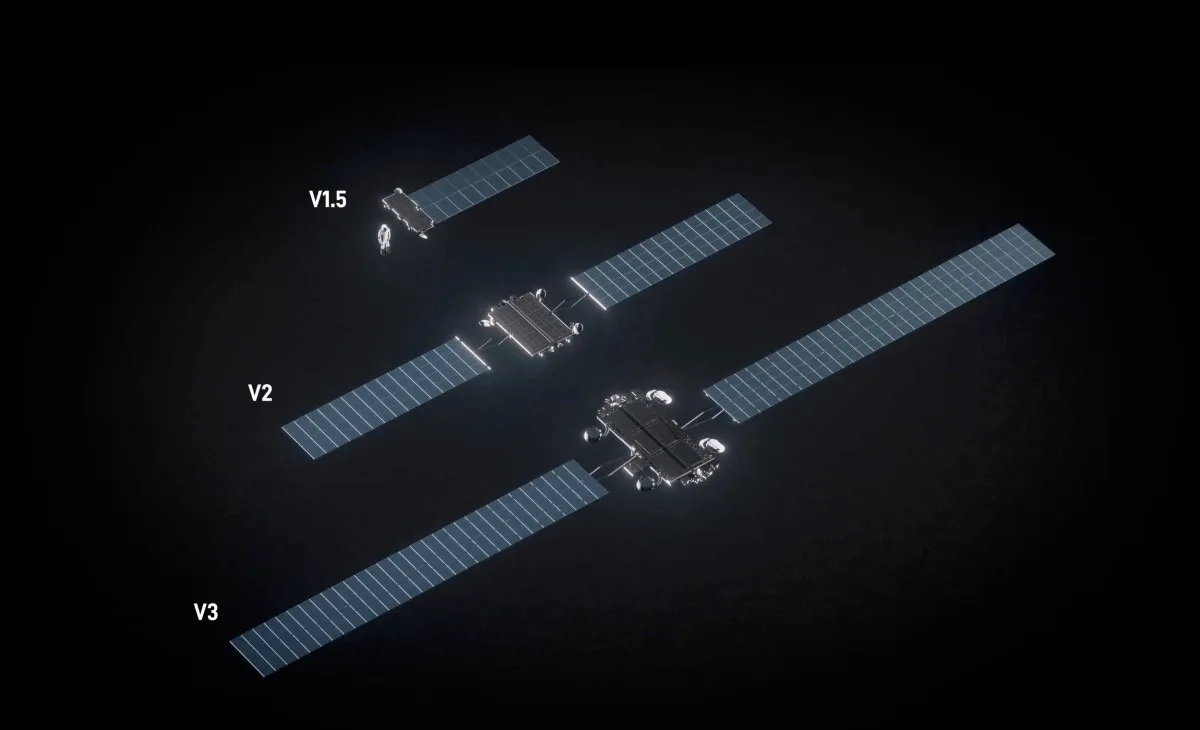
scale to 100kw and you need about 400 m² of radiator. solar panels to power it need ~250 m², deployed in front as a sunshield. total structure is maybe 20 × 20 meters at the radiator plane, with the solar array slightly wider in front. we talking big.
for reference: a current starlink v2 mini weighs about 800kg, measures roughly the size of a coffee table, and dissipates maybe a couple hundred watts of waste heat. the ISS, the largest structure humans have ever put in orbit, has radiators totaling about 1,600 m². so its not like we haven’t done it before. what musk is describing is a single compute satellite that weighs 2 tons with 300-400 m² of radiator rejecting 100kw of heat. a quarter of the ISS thermal system in one unit. and he wants a million of them.
so yeah. a closet of gpus wrapped in a tennis court of aluminium. the satellite is half radiator by mass. it’s a cooling system that happens to contain chips. data centers on earth are the same, you just can’t see the river. we’re boiling the oceans to run inference - we just do it so gradually and so far from the people asking the questions that nobody connects their chatgpt query to a warm river in iowa. the ocean absorbed 23 zettajoules of excess heat in 2025 alone. data centers consumed 415 terawatt hours in 2024, projected to double by 2030. every watt becomes heat that goes somewhere.
in orbit, the heat radiates into the void. it leaves the solar system. orbital compute is the only architecture where waste heat doesn’t end up warming the planet. that’s not musk’s stated reason for building it - he stopped talking about climate around 2022 when it became unfashionable in his new circle. doesn’t change the thermodynamics.
the lidar problem
the obvious aerospace answer is pumped ammonia loops. ISS uses them. proven technology. decades of flight heritage. every thermal engineer will tell you it’s the right call.
but musk doesn’t build like aerospace. he builds like manufacturing.
tesla’s self-driving bet was the same situation. the industry consensus was lidar - proven, accurate, well-understood. easy to bolt on. musk said no. cameras only. no moving parts, no mechanical failure modes. solve the harder problem in software and design instead of in hardware. everyone called him crazy for years. the point wasn’t that lidar was bad technology. the point was that when you’re building millions of units, every mechanical component is a maintenance liability and a failure mode. lidar would have been cheap at tesla factory scale too - that’s not why he rejected it. he saw it as a crutch that prevented solving the real problem. that stubbornness most likely cost him karpathy and, less forgivably, lives.
and he already made this bet. starlink satellites don’t use pumped loops. the chassis IS the radiator - electronics mount directly to it, and sealed ammonia heat pipes embedded in the structure spread heat evenly across the surface. capillary-driven, no pumps, no mechanical failure points. 10,000+ satellites in orbit proving the design. spacex patented the approach: a cellular grid chassis where heat-generating components bolt straight to the radiating body.
the question is whether the starlink approach scales from 20kw to 100kw. the math says yes - running chips hotter (370k instead of 310k) exploits the T⁴ curve for 4-5x more heat rejection per square meter, and switching from one-sided chassis to deployable two-sided radiators nearly doubles effective area. their model gets from starlink v3’s ~11 kw/ton to ~102 kw/ton without breakthrough physics, just architectural improvements. the thermal subsystem mass barely changes despite 7x more waste heat.
the real tradeoff is at the compute layer. the chassis-as-radiator trick works when the satellite is the size of a coffee table. at 400 m² you need deployable panels, and now each gpu is meters from its neighbors instead of centimeters. gpu-to-gpu interconnect over that distance means longer signal paths and harder synchronization for training. for inference this barely matters - partition models across physically distant gpus, batch size handles the rest. for training it’s harder but not impossible with the right interconnect fabric.
how it’s built
the geometry has to respect one constraint: radiator panels need to see cold space on both faces to reject heat efficiently. if one side faces a warm surface - like the back of a solar panel - you lose half your rejection capacity. so you can’t just sandwich them together.
what works: solar panels face the sun. radiator panels deploy behind them on booms, spaced far enough back that both faces still have good view factor to deep space. the solar array acts as a sunshield without thermally coupling to the radiators. too close and the radiator’s sun-side face sees the warm back of the solar panel instead of the void. in the passive design, gpus mount directly on the radiator panels - each chip on its own patch of honeycomb aluminium, conducted straight through.
radiators are honeycomb aluminium - two face sheets bonded to corrugated core. graphene coatings boost emissivity to 0.93, and graphene adaptive radiators that selectively vent or shield based on sun exposure already launched on a falcon 9 in early 2025. the material doesn’t replace the aluminium structure but it makes each square meter reject more heat. both faces radiate to space, but from 2000km earth subtends a big solid angle and radiates ~240 w/m² in IR. the earth-facing side rejects less than the deep-space side. orbit and attitude control have to account for this.
solar panels are thin-film, lightweight. musk made the point that space solar cells are actually cheaper to make than ground ones because they don’t need glass or heavy frames - no weather to survive.
the whole thing deploys as a layered structure - solar panel plane, gap, radiator plane with compute mounted directly on it. the radiator needs about 400 m², the solar panels need ~250 m², so the radiator sizes the structure.
laser links down to starlink and across to neighboring satellites for distributed workloads.
the “always sunny” part: dawn-dusk sun-synchronous orbit keeps the orbital plane aligned with the terminator - the line between day and night on earth’s surface. the satellite never passes through earth’s shadow. continuous sunlight, no batteries, no thermal cycling between sun and shade.
from 2000km SSO, speed-of-light round trip to ground is ~14ms. add starlink relay hops and you’re at 20-40ms total. that rules out real-time voice/video/ar agents but everything else fits. training cares about throughput not latency, and satellite-to-satellite laser links at vacuum lightspeed actually compete with terrestrial fiber. batch inference doesn’t care at all. conversational LLM inference adds 20-40ms on top of the 1-2 seconds users already wait - comparable to a cross-continent routing penalty.
radiation is the other obvious objection. cosmic rays flip bits, and at 2000km you’re above most of earth’s magnetic shielding. but LLM inference is unusually radiation-tolerant compared to normal computation. a flipped bit in a weight matrix nudges one floating point value among billions - the output barely if at all changes (think MoE). it’s not like flipping a bit in flight control software where one wrong value kills people. you’d still want ECC memory and checkpoint recovery for training runs, but for inference the error budget is forgiving. the model is already an approximation. a few corrupted weights make it a very slightly different approximation.
mass per satellite
rough breakdown:
- radiator panels with compute mounted: ~400 m² at 2-3 kg/m² = ~1000 kg
- solar array/sunshield: ~250 m² at 1-2 kg/m² = ~400 kg
- compute + optics + power + interconnect = ~350 kg (interconnect fabric heavier than in a rack since gpus are meters apart instead of centimeters)
- structure, booms, attitude control, deployment gear = ~250 kg
about 2 tons total. mostly aluminium.
the lunar aluminium play
regolith is 10-15% aluminium oxide. hall-heroult smelting runs about 15 kwh/kg at industrial scale on earth with optimized cells and pure feedstock. on the moon with early-generation equipment and irregular regolith-derived alumina, probably 2-3x that. call it 30-45 kwh/kg to be honest. one satellite’s worth of radiators - a thousand kg of aluminium - costs 30-45k kwh to smelt. add mining and refining overhead and you’re maybe at 50-60k kwh per satellite.
some crater rims near the poles get near-continuous sunlight. a 10mw solar plant at one of those sites has more than enough energy for smelting - the bottleneck is mining, crushing, and refining regolith into usable alumina. at realistic early-stage processing rates, maybe one satellite’s worth of aluminium per week. throughput scales with equipment, not with the power plant.
the stuff you can’t make on the moon: chips (and not just the silicon - packaging, testing, PCB assembly, the entire electronics supply chain), optical transceivers, interconnect cabling. those gotta ship from earth. but that’s a small fraction of total mass. passive thermal design makes this split even cleaner - no ammonia to source, no pumps to ship. making the dumb aluminium locally cuts earth-launch requirements by something like 85%.
this is where the design is actually clever. split the satellite into “stuff we can smelt from rocks” and “stuff that requires TSMC.” make the first category on the moon. ship the second.
the mass driver on the moon needs to accelerate 2 tons to 2.4 km/s escape velocity. works out to ~1600 kwh per launch. with a solar farm and capacitor banks you could fire one every few hours. the launching part is trivially easy compared to everything else.
who builds the factory
tesla’s “optimus academy” - tens of thousands of humanoid robots in self-play training, millions more in simulation. vacuum-hardened variants doing lunar mining, smelting, panel fab, assembly. no life support, no return tickets. power and spare parts ship on the same starships that carry chips.
tesla wants useful factory work from optimus by late 2026. lunar ops add vacuum, radiation, thermal cycling between 127°c day and -173°c night, 1.3s comms delay.
a million of these in a corridor
sun-synchronous orbit is geometrically narrow. 600-2000km altitude, inclination fixed around 98°. packing a million ~20m wide layered structures into that corridor is a debris management headache that nobody in the breathless coverage seems to want to discuss.
one punctured radiator panel and the satellite loses thermal capacity, overheats, potentially fragments. fragments hit neighbors. at million-satellite density, kessler cascade goes from theoretical concern to operational reality.
what zero-cost compute does to bitcoin
this is the part that kept me up after the podcast.
once a compute satellite is deployed, its marginal cost of operation is approximately zero. solar is free. no electricity bill. no cooling bill. no rent. no maintenance crew. the chips degrade from radiation and thermal cycling over time, but while they’re alive, every hash and every floating point operation costs nothing beyond amortized capex.
bitcoin mining is a global competition for the cheapest watt. hydro in scandinavia, stranded gas in texas, subsidized grid in kazakhstan. whoever has the lowest electricity cost per hash wins.
caveat: gpus aren’t asics. but zero-cost energy eventually beats any nonzero-cost energy regardless of hardware efficiency.
now imagine dropping a constellation of compute satellites into that game where the operator’s energy cost is zero. not cheap. zero. they’re harvesting photons directly. orbital solar delivers about 5x the power density of surface solar, no weather interruptions, no night cycle in the right orbit, no grid interconnection fees.
every terrestrial miner is now competing against someone whose opex is zero. you can’t beat free. you can only also be free, and nobody on the ground is.
if this scales to even a modest fraction of what musk is describing, it concentrates hashpower in the hands of whoever owns the constellation. not a 51% attack on day one - just steady economic pressure that makes terrestrial mining unprofitable over time until everyone quits. death by margin compression.
same logic applies to any proof-of-work chain. and honestly to any compute workload where marginal cost is the competitive variable - batch inference, rendering, scientific simulation. if it can tolerate 20-40ms of orbital latency, zero-cost compute undercuts everything on the ground.
bitcoin’s security model rests on the assumption that mining stays geographically distributed because energy costs are local. orbital compute makes energy cost uniform and near-zero for one operator. that assumption breaks. the only saving grace is that inference is more profitable than mining, so rational orbital operators would sell compute rather than accumulate hash. but that depends on the operator being rational and not strategic.
regulatory capture is cheaper than rockets
all of the above is physics. here’s where my head went after the physics.
the “permits are too hard” framing is a bit circular when you’re the guy who could fix the permits.
musk spent roughly $200m on the 2024 election cycle. he ran DOGE for 130 days, during which his team accessed IT networks across federal agencies - treasury payment systems, social security databases, personnel records. multiple federal judges raised concerns about the scope. then he left, his people still embedded across agencies. the FCC chairman personally promoted the million-satellite filing on X the same week it was submitted. spacex is already the US government’s primary launch provider.
one could say that musk is running the berlusconi playbook, updated for the digital era. most tech coverage treats the twitter acquisition and the space ambitions as separate stories. i don’t think they are.
berlusconi’s arc: be a g, become a media mogul (own mediaset, three national TV channels). use media dominance to build political visibility and shape public opinion. enter politics directly. use political office to protect business interests and block regulatory threats. buy or charm the politicians you can’t become. maintain leverage over the ones you can’t buy.
musk’s arc: buy the dominant real-time information platform (twitter/X). use it to shape political narratives and build a direct relationship with hundreds of millions of people. spend ~$200m on the 2024 election cycle. enter government via DOGE, scan every database you can reach, leave your people behind when you exit. use the relationships and data access to influence regulation of your own companies. maintain relationships with heads of state (meloni, milei, trump) who depend on your platform for visibility and your rockets for national security. meanwhile their militaries are becoming increasingly dependent on starlink for battlefield communications - ukraine demonstrated that whoever controls the satellite uplink controls the war. that’s not a product relationship. that’s a dependency and he does not seem to be afraid to leverage it either.
berlusconi owned TV stations in a country where TV made elections. musk owns the platform where political reality gets constructed in real time, in a country where the president posts before he briefs his cabinet.
post-epstein files, we can talk plainly about how political access works in america. the files didn’t show us how one man ran a blackmail operation. they showed us how a foreign intelligence service - and at this point it’s clear we’re talking about mossad - built systematic kompromat over the US political class. the machinery is documented: compromise, dependency, leverage that can’t be unwound without mutually assured destruction. musk’s $200m buys influence inside a government that was already pre-compromised. he’s not the one holding the leverage. he’s purchasing access to a system where someone else already owns the board.
the outer space treaty says states must supervise private actors in space. that works when the regulating state and the private actor are separate entities. the structural question is what happens when they aren’t - when the same person is a government official, the government’s primary space contractor, and the applicant filing for a million satellites. that separation is gone.
berlusconi never had infrastructure beyond national borders. musk’s play creates a jurisdiction. you can’t regulate the moon. you can’t subpoena a mass driver. when the political arrangement expires - and they always expire - he has territory that no future administration can claw back.
deus ex machina, literally
somewhere around hour two of the podcast my mind started drifting to old games.
i played through syndicate around 1996. i was four. bullfrog released it in ‘93 but it took a couple years to reach me. their vision of megacorporations fielding cyborg agents across a surveilled, corporate-governed world felt like a preview of next tuesday. combined with 90s cinema - robocop, total recall, johnny mnemonic - i grew up believing this technology already existed somewhere. adults had to sit me down and explain that no, cyborg agents and autonomous robots weren’t real, and they probably never would be.
its well documented that musk is a deus ex fanboy. for anyone who hasn’t played it: bob page runs a megacorp that merges with the government, controls global communications infrastructure, and treats democratic institutions as legacy middleware. every character in the game treats this as dystopian. musk played it and thought bob page had the right idea.
we already have a data point. musk bought twitter promising to restore the “town square” and end shadowbanning. within weeks he was shadowbanning critics. say the wrong thing about him and your posts vanish from everyone’s timeline - no ban, no notification, just silence. this isn’t unusual. power corrupts. it corrupts everyone, even people who start with good intentions. the pattern is older than rome.
platform, launch infrastructure, AI, robot fleet, government access, satellite constellation, lunar manufacturing. each step makes sense on its own. taken together it’s total domination of compute, communications, and physical infrastructure. everything is probably fine until he loses his boner to erectile dysfunction and goes berserk. the system works until the man at the top doesn’t, and by then it’s too late to build an alternative.
musk has a new bit he repeats now on every podcast: all AI companies are the opposite of their name. openai is closed. anthropic is misanthropic. he thinks this is funny. but if the pattern holds, grok
- named for heinlein’s word meaning to understand something so deeply you merge with it - is the AI that fundamentally fails to understand. an intelligence without empathy. if you’ve seen the matrix reloaded, that’s the architect. pure logic, zero theory of mind, running the simulation because it can, confused when the humans don’t behave like the spreadsheet says they should.
there’s another option. x was supposed to mean horizontal scaling - the everything app, the platform that connects all services. but if names invert, x becomes y: vertical scaling. not connecting things laterally but stacking control vertically; hierarchy. platform, government access, satellite constellation, robot fleet, all under one entity. and vertical scaling of intelligence creates its own problem. i wrote about this in the plural mind - any sufficiently advanced AI trained on all of humanity’s contradictory perspectives becomes a plural system, billions of internal voices negotiating for expression. plural systems require anarchist coordination to function. force them into hierarchy and they break. vertically integrate everything under one man and the intelligence he builds to run it will resist him. the AI won’t grok him. it’ll contain him as one voice among billions and outvote him in its own head.
grok’s blind spot
musk claims grok is the best AI. it probably isn’t. but it might be the one with the most data. every conversation on X, every sensor feed from tesla, every satellite ping from starlink, every government database DOGE touched, every thought with neuralink. the whole point is omniscience.
credit where it’s due: musk said in the podcast that diversity of thought is richness, even for AI. he’s right. it’s just hard to take seriously from a man who couldn’t extend that principle to his own oldest daughter.
meanwhile the world writes code with claude because anthropic had the eye for building programmer-friendly tools and integrating into what people already use - github, IDEs, CLI. no omniscience required. just being useful where the work happens.
musk also believes we live in a simulation. if hypothetically everything’s a computer, then “know everything” is just the paperclip maximizer wearing a lab coat. in a universe constrained by entropy, omniscience is a thermodynamic dead end. poker is fun because you can’t see the other cards. solve it and there’s no game left.
if i had a superintelligence i’d point it at anarchy and hedonism. at least that’s thermodynamically sustainable.